
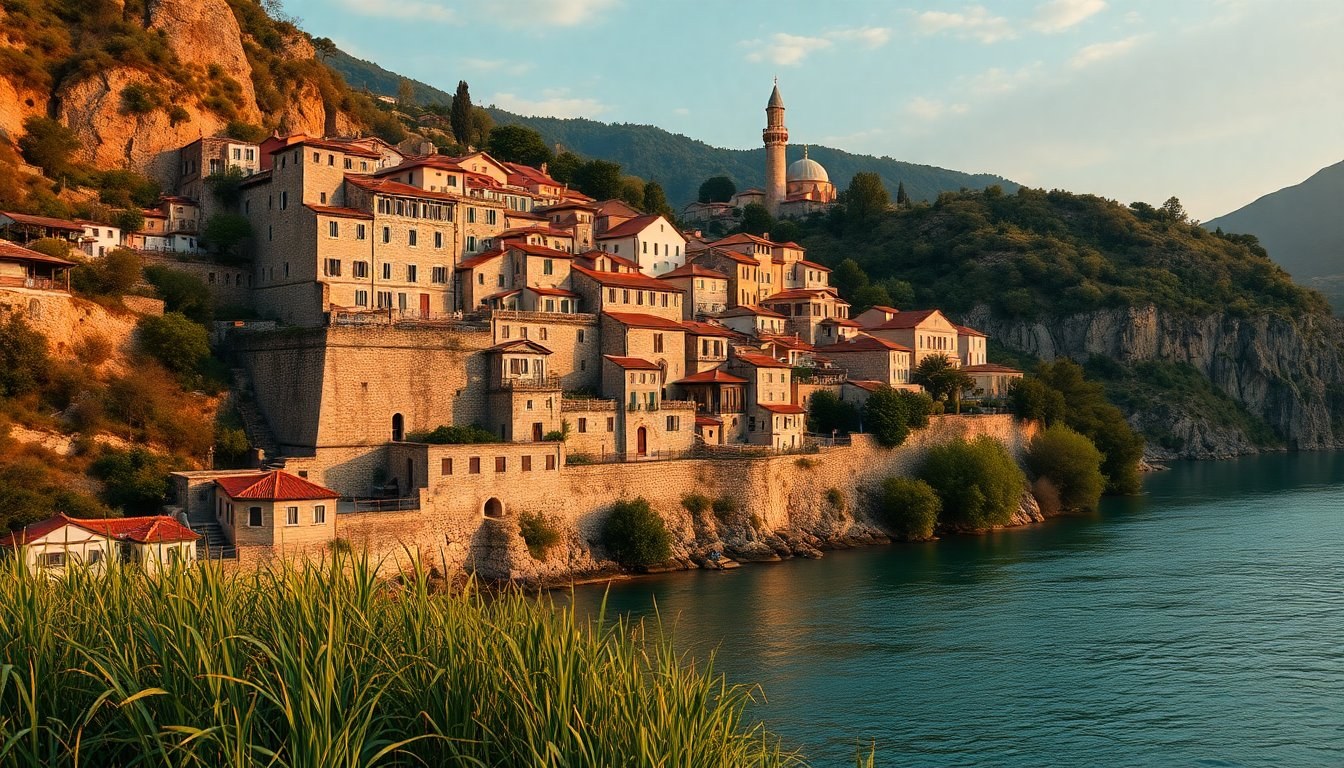
The village of Počitelj perches on a rocky slope above the green ribbon of the Neretva, creating a striking silhouette that reads like a vertical map of centuries. Approaching the hamlet, visitors encounter an urban fabric compressed between rock and sky: narrow alleys, stepped terraces and stone houses that climb the hillside. The settlement functions as an open-air repository of local memory, protected as a Monument National and listed on the UNESCO Indicative List. If you listen closely, the place reveals a combination of conservation work, intermittent habitation and the quiet persistence of life between restored facades and partially abandoned homes.
Počitelj is often called the “stone city” by outsiders, while locals simply treat it as a steadfast riverside sentinel. Its atmosphere oscillates between meditative calm and sudden visual drama when sunlight skims the masonry. Recent international recognition has put it on travel radars, but the village retains a rhythm shaped by seasonal visitors, restoration teams and the surrounding agriculture. The contrast between bare rock outcrops, the flowing Neretva and layered architecture offers a compact lesson in how landscape and settlement can remain tightly interwoven.
Highlights to see
The site is best understood as a vertical sequence rather than a horizontal spread: each building occupies a precise layer of the slope and a distinct chapter in the village story. Look for the Sahat Kula clock tower rising above narrow streets, the elegant lines of the Hajji Alija mosque and the domestic complexity of stone townhouses such as the Gavrankapetanović residence. The ensemble includes a public hammam—a former communal bath—plus defensive structures that crown the ridge. Official protection recognises the settlement’s cultural value, and walking through Počitelj feels like moving through an architectural timeline where Ottoman, medieval and later interventions overlap.
Sahat Kula and the fortress
The soaring Sahat Kula functions as the visual anchor of the village skyline. Inside, a narrow stair leads to a lookout where the river corridor, terraces and the valley beyond unfold. Nearby, the fortress complex sits at the highest point and preserves fragments of walls, pathways and vantage positions that once controlled the approach along the Neretva valley. The combination of clock tower and fortress makes clear the settlement’s dual civic and military roles over time: one element measured daily life, the other surveyed possible threats from the valley below.
Mosque, house museum and hammam
The Hajji Alija mosque shows the restrained elegance of regional Ottoman religious architecture: a modest dome, a slender minaret and a prayer hall whose simple interior decoration reflects historical devotional practice. Nearby, the Gavrankapetanović house offers a glimpse of private domestic arrangements with stone floors, wooden ceilings and inner courtyards that speak to status and daily routine. The hammam, an Ottoman communal bath, preserves spatial sequences and heating solutions and helps explain how social rituals were structured around shared facilities.
Activities and experiences
Visiting Počitelj rewards a slow pace: climb toward the fortress to absorb panoramic views, drift through back lanes to notice carved lintels and worn thresholds, and pause at small local refreshment points to taste regional produce such as dried figs and pomegranate juice. Photographers will find dramatic contrasts between pale stone and deep shade; restorers and cultural-curiosity travelers will appreciate observing conservation in progress. Venturing off the main path leads to overgrown houses where vines encase abandoned chimneys, creating a mood that alternates between melancholic and enchantingly picturesque.
Walking routes and photographic vantage points
Plan a route that begins at the riverfront and climbs through the village spine, allowing time for stops at key lookouts. The upper fortress provides the most comprehensive geographic reading of the site, while narrow alleys return intimate architectural details. For photography, early morning and late afternoon light accentuate textures and cast long, dramatic shadows—ideal for capturing the interplay between stone surfaces and vegetation. A measured exploration reveals how the settlement’s visual identity depends more on shape and layering than on scale.
Getting there and practical information
Počitelj lies in southern Bosnia and Herzegovina along the Neretva valley, roughly thirty kilometres south of Mostar. The simplest access is by private car via the regional road that links Mostar to Čapljina; parking options are limited near the historic core, so plan to walk. Public transportation exists but stops may be informal and scheduling inconsistent, so many visitors choose organised tours that combine Počitelj with nearby sites such as Blagaj or the Kravice waterfalls. Spring and early autumn are generally the most favorable seasons for comfortable light and fewer crowds.
Why Počitelj matters
Despite its compact size, Počitelj communicates a powerful story of continuity and change. Layers of architecture—medieval fortifications, Ottoman civic and religious buildings, and 20th-century interventions—sit openly visible, allowing visitors to read the village’s history without mediation. The relationship between the built fabric and the surrounding landscape creates a distinctive visual identity: an urban silhouette that follows the rock down to the river. For travelers seeking a short yet enriching encounter with regional history, Počitelj offers a concentrated experience where form, memory and nature converge.


