Government records about Bigfoot have surfaced again, and this time the paperwork comes from the U.S. Forest Service. The files concern a series of unusually large footprints reported in the Umatilla National Forest in northeast Oregon, and they were released in late November 2026.
The 1982 investigation at Low Creek
The central document is a six-page report filed in June of 1982 by Rodney L. Johnson, a wildlife biologist working for the Forest Service. Johnson filed it on June 18, 1982, the day after he went with a group into the Mill Creek Watershed of the Blue Mountains to look into a reported find of Bigfoot tracks in the Low Creek drainage.
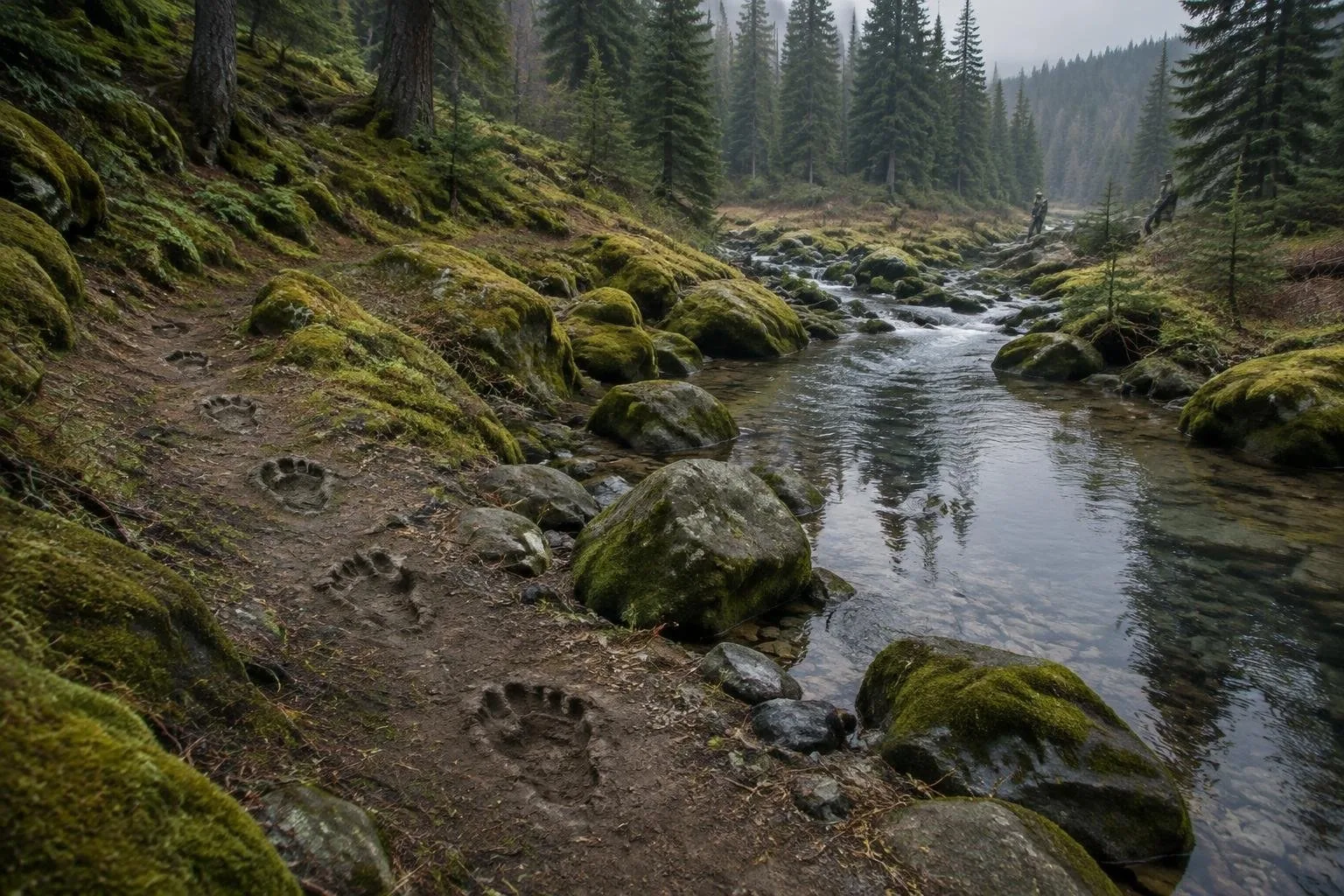
The report describes two sites along the Low Creek trails. At one, six identifiable tracks ran about 25 feet down the trail. At the second, roughly 18 prints stretched about 40 feet. The group photographed the tracks and made two plaster casts at each site. Some prints measured about 15 inches long and as wide as 7 inches. A third set of tracks was reported, but the group did not examine that location because of the time of day and what they had already found.
Johnson concluded that the tracks were made by “something other than a 300 pound plus two footed being.” His reasons included a stride that stayed the same on the slope, prints that did not sink deeply into the mud while the investigators’ own boots did, and tracks with a clear beginning and end. He also noted that the forest litter at one site appeared to have been pushed aside in an unnatural way, and that several prints looked as if the foot had been rocked from side to side. He wrote that if the tracks were faked, the forger had taken great trouble over the detail.
A hoax theory and the memo that closed the case
The following month, Joel Hardin, a Border Patrol agent based in Bellingham, Washington, answered Johnson’s report in a one-page memorandum. Hardin had been part of the team that looked at the tracks, and he later retired from the Border Patrol and started a tracking business in Oregon.
Hardin wrote that the tracks were a clever hoax. He suggested that a soft plaster or rubber-coated foot may have been used, and that the person responsible was likely someone with normal access to the area who knew Bigfoot stories well. He still closed on a light note, saying it had been a pleasure and a privilege to investigate the case, and he expressed hope that the memo would be enough to close it.
The investigation followed a report by Paul Freeman, a former Forest Service patrolman, who said on June 10, 1982 that he had found three sets of large footprints in the Mill Creek watershed. Freeman later made a video in the Blue Mountains in 1994 that he claimed showed a bigfoot. Some Bigfoot investigators consider that video authentic.
The other records released with the files
The Forest Service released three Bigfoot records through its Reading Room, a webpage where the agency posts documents it often receives through Freedom of Information Act requests. The other two concern Montana. One is a 2003 newspaper article from the Clark Fork Valley Press about large humanlike footprints. The other is a 1980 history of the Petty Creek area that includes an account of a 1949 hunting party. The hunters found elk entrails and a set of bipedal tracks leading away, followed the tracks, and decided they were not particularly anxious to catch up to whatever it was.