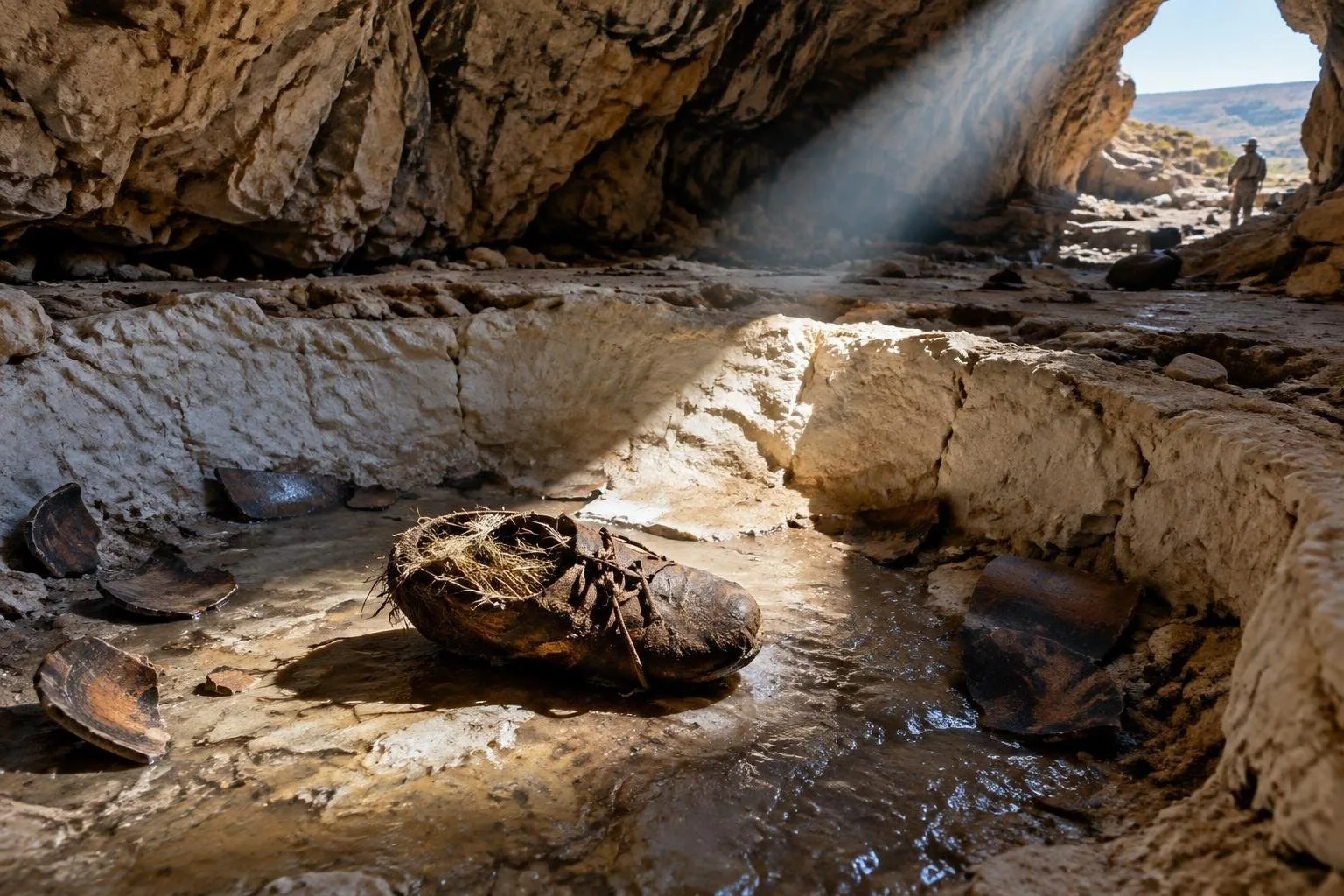
The world’s oldest known footwear suddenly resurfaced after more than five millennia of darkness. A single piece of cowhide, cut, stitched and laced, emerged from the depths of Armenia’s Areni 1 cave, offering a rare glimpse into the daily life of people who roamed the landscape between 3600 and 3500 BC.
Excavations carried out in 2008 uncovered the shoe lying upside down at the bottom of a shallow, plaster-lined pit. Directly beneath a broken Chalcolithic ceramic bowl, the artifact was protected by several layers of compacted sheep dung, a natural barrier that kept moisture and contaminants at bay for thousands of years.
Preservation clues inside the cave
The shoe remains remarkably intact, retaining its original leather laces and a stuffing of dried grass. Archaeologists suggest the grass served either to preserve the shoe’s shape or to provide warmth for the wearer’s foot. Measurements align the find with a modern US size 7, which corresponds to EU size 37 and UK size 6. The exact gender of the wearer cannot be determined from the current evidence.
Its survival is largely owed to the cave’s cool, dry microclimate. The sealed environment, insulated by dung layers, prevented decay and allowed the leather to retain its flexibility. Inside the pit, the shoe was positioned upside down, a detail that may reflect how it was discarded or simply the result of sediment movement over millennia.
Dating the artifact and its cultural context
Radiocarbon analysis placed the shoe firmly within the early Chalcolithic period, yielding a calibrated age range of 3600-3500 BC. This timeframe coincides with the emergence of early metalworking in the region, suggesting that the shoe’s owner lived during a transformative era of technology and trade.
The proximity of the footwear to a broken ceramic bowl hints at a possible ritual or domestic setting. The bowl, identified as Chalcolithic in style, further anchors the shoe within a particular cultural layer of the cave’s occupation. Together, these finds enrich our understanding of how prehistoric communities fashioned, used, and eventually deposited everyday objects.