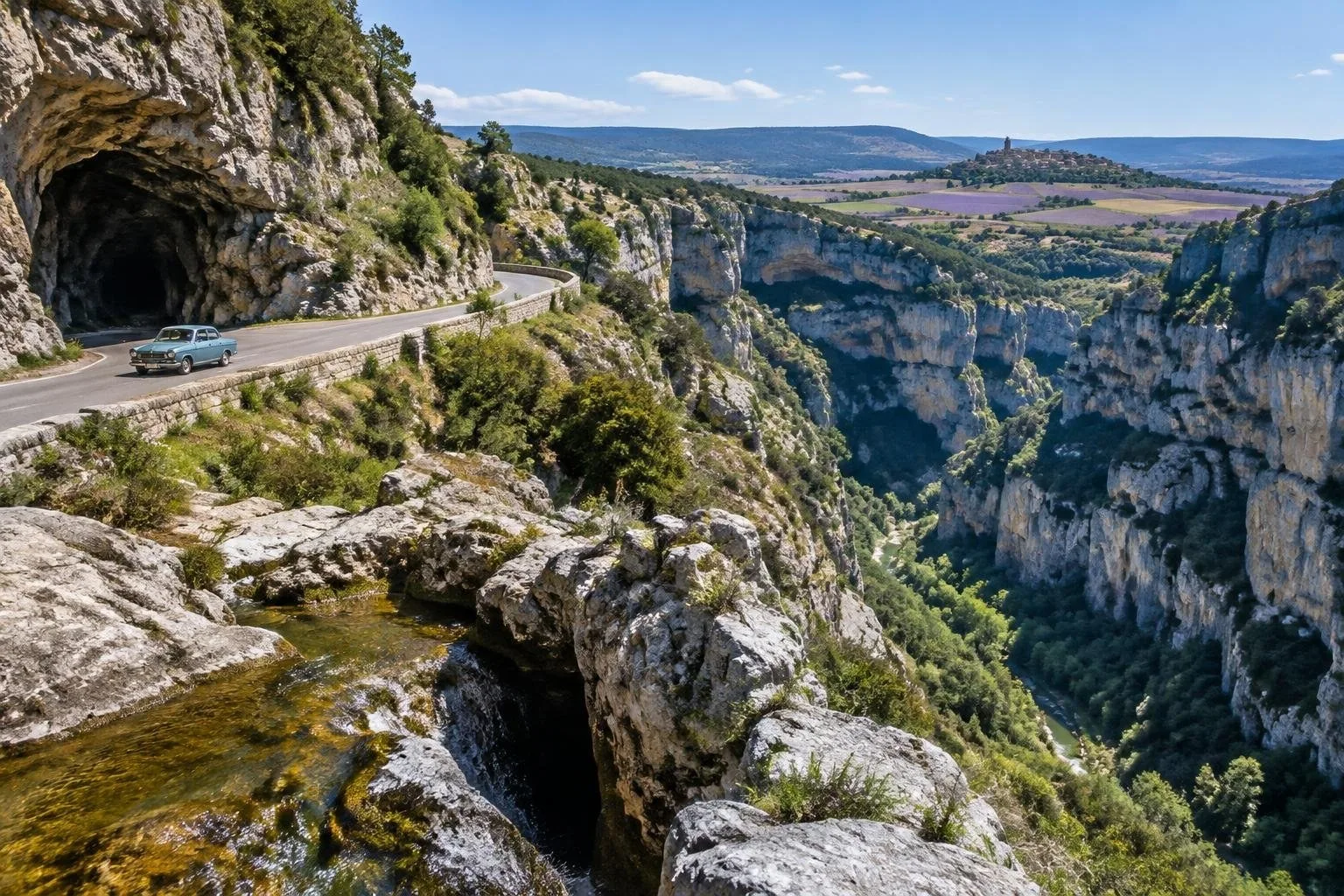
The Nesque Gorges cut a deep scar through the limestone plateaux of the Vaucluse department, offering a dramatic encounter for anyone who follows the winding D942. Beyond the lavender fields and sun-baked villages that define Provence, this canyon plunges more than 400 meters, creating a natural amphitheatre of rock, water and history.
How the canyon was born
Millions of years ago, shallow seas deposited layers of calcareous sediment that later rose and folded under tectonic pressure. The modest stream called the Nesque exploited fractures in this limestone, gradually eroding a 20-kilometre gorge that today reveals sheer walls, white stone blocks and unexpected sinkholes. When the river dries in summer, a large portion of its flow disappears into subterranean passages, re-emerging only after heavy rain: a classic example of a karst system.
Archaeological digs along the gorge have uncovered flint tools, animal bones and other traces of hunters who lived here about 150 000 years ago. One prominent rock formation, the Rocher du Cire (“Wax Rock”), earned its name from swarms of wild bees that once filled its cavities.
Driving, hiking and cycling the D942
The D942 runs between Villes-sur-Auzon and Monieux, hugging the gorge’s edge and threading through rock-carved tunnels. Along the way, the road seems to touch the cliff before opening onto a 300-metre precipice at the Belvédère du Castellaras. From this viewpoint, the Rocher du Cire appears in shades of gray and ochre, framing the void below.
For walkers, a network of trails descends into the canyon’s heart. The trail system includes sections of the GR9 that cross the Monieux sector, offering both short panoramas and more demanding climbs beside the torrent. Near the bottom, under a massive natural overhang, stands the 12th-century Saint-Michel d’Anesca chapel. Built of stone, the chapel is partially sheltered by the rock itself, creating a striking blend of human craftsmanship and geological protection.
Cyclists favor the roughly 21 kilometre stretch from Villes-sur-Auzon to Monieux, where a steady ascent rewards riders with expanding vistas of the gorge and surrounding vineyards. Longer loops stretch toward Méthamis and the forest of Javon, adding variety to the ride.
Nearby villages and practical access
At the top of the drive, Monieux presents narrow cobblestone lanes, stone houses and fields of lavender and farro, embodying the charm of high-Provence. Down the slope, Villes-sur-Auzon retains a circular medieval layout, surrounded by vineyards that belong to the AOC Ventoux designation.
Reaching the gorge is straightforward by car. From Avignon or the A7 autoroute, follow signs for Carpentras, then Mazan, until Villes-sur-Auzon appears on the horizon. The road itself is part of the experience, so a vehicle is recommended. Entry to the natural site is free; hikers should obtain trail maps at local tourist offices.
The entire area forms part of the Mont Ventoux biosphere reserve, recognized by UNESCO for its unique flora, fauna and cultural heritage. Whether you drive, walk or pedal, the Nesque Gorges deliver a compact yet unforgettable Small trip through one of Provence’s most striking landscapes.