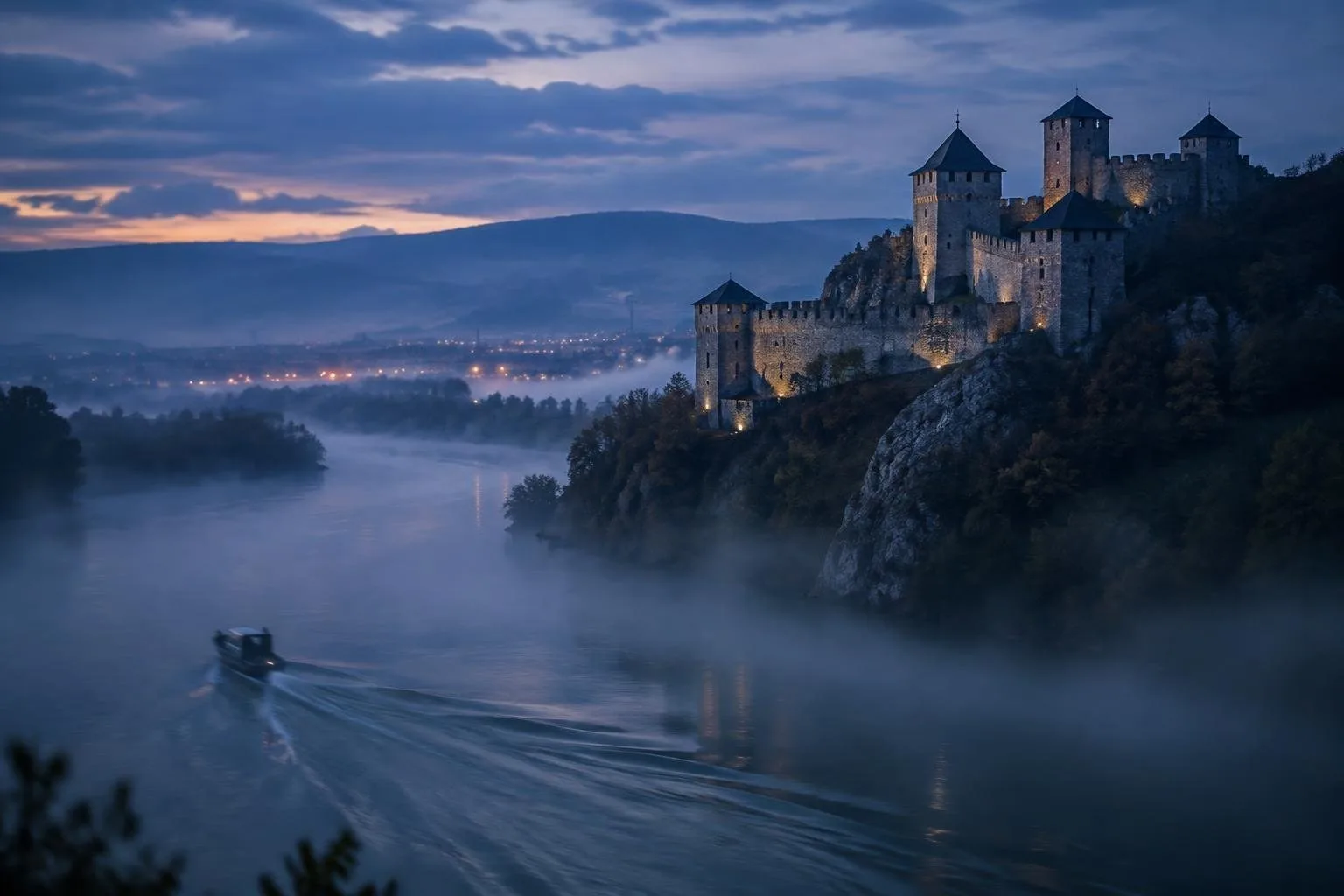
The Maglič Fortress dominates a steep promontory near Kraljevo, Serbia, rising about 100 metres above the winding Ibar River. From a distance the stone complex resembles a colossal crown perched on a mountain, while the river carves a tight loop that looks like a necklace protecting a secluded medieval enclave. The site is often dubbed the “Serbian Camelot” because its silhouette and lingering mist evoke the legend of King Arthur’s castle. The name Maglič itself derives from the Serbian word for fog, a frequent visitor to the valley that adds an ethereal glow to sunrise views.
History, myths, and the people behind the stones
Archaeological evidence points to an earlier fortification from the 12th century, but the present walls mainly date from the late 13th to early 14th century. Between 1324 and 1337 the citadel expanded to include residential quarters, clerical buildings, and the Church of Saint George, which received new architectural elements and frescoes during that period. Ottoman forces likely took control around 1455, turning the fortress into a garrison that monitored traffic on the Ibar. Later, the site saw action in Habsburg-Ottoman wars and again in the 1815 Serbian uprising.
Local folklore attributes the construction to Prokleta Jerina, the “cursed” wife of despotic ruler Đurađ Branković, labeling the ruins “Jerinin grad” despite the chronological mismatch—Jerina lived in the 15th century, long after the initial building phase. A more romantic tale claims that King Uroš I planted rows of white and blue lilacs along the riverbank to welcome his future bride, Elena d’Angiò, creating the famed “Valley of Lilacs.” While historians lack proof, the stories enrich the fortress’s cultural tapestry.
Architecture and what visitors can see
The fort’s defenses consist of eight towers: seven along the curtain wall and a massive donjon that reaches roughly 20 metres in height. The remaining towers stand about 10 metres tall. Walls built from local stone and lime mortar are up to 2 metres thick and trace an irregular perimeter of approximately 270 metres, enclosing just under 2 200 square metres. One side relies on natural cliffs and the Ibar, while the opposite flank is protected by an artificial ditch cut directly into the rock.
Inside, the ruins reveal a once-thriving palace complex with a second-storey hall illuminated by four windows, residential blocks, service areas, and a small necropolis—a rare find for a fortress lacking a permanent settlement. Remnants of an ancient oven and two water cisterns illustrate the careful planning for long sieges. The Church of Saint George remains a focal point; excavations uncovered fragments of 14th-century frescoes that hint at the interior’s former splendor.
Visiting the citadel and practical tips
Approaching the stronghold from the valley requires a short ascent along a rocky slope, after which the layout of walls, towers, and building fragments opens up, giving a clear sense of a medieval citadel. The main gate faces north, complemented by a smaller southeastern entrance. A man-made trench on the Stolovi side adds to the defensive impression. Visitors should wear sturdy shoes, stay alert for uneven ground, and respect sections still in ruin.
Panoramic views dominate the experience. From the accessible terraces, the Ibar serpentines through a series of bends, flanked by verdant slopes and distant peaks. The atmosphere shifts with the fog that often rolls in during early mornings, reinforcing the fortress’s nickname. Seasonal considerations matter: a floating bridge service, reinstated by the volunteer group Magličgrad in 2022, transports hikers across the river, but its operation depends on water level and weather, especially outside the summer months.
How to reach Maglič Fortress
The citadel sits about 20 kilometres straight-line from Kraljevo and roughly 30 kilometres by road toward Raška and Novi Pazar, nestled within the Stolovi mountain range. Travelers follow the south-bound road that shadows the Ibar River; the fortress rises sharply above the road, its towers forming a distinctive silhouette. The original pedestrian bridge was destroyed by a flood in; since 2022 a seasonal raft service provides the crossing needed for the final hike. Prospective visitors should check the current status of the raft with Kraljevo’s tourist office, particularly in autumn or winter, when water levels can limit access.