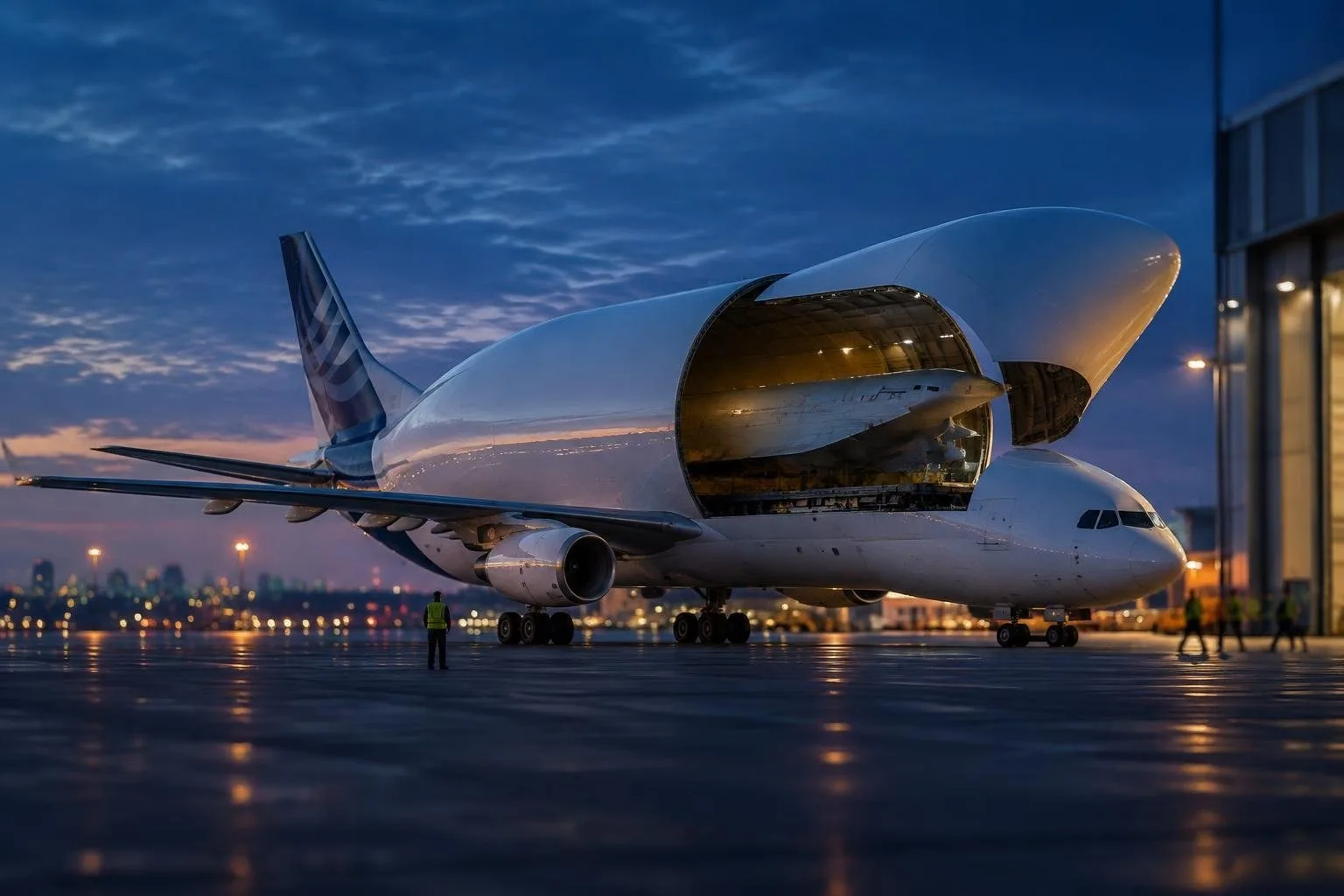
The Airbus Beluga XL is not a fantasy creature; it is a fully functional transport aircraft that has become an icon of modern aviation. Its rounded fuselage and lowered cockpit give it the silhouette of a white whale, but every curve serves a purpose. Designed to ferry oversized aircraft components, the Beluga XL replaces older models and enables Airbus to move parts between factories spread across the continent without resorting to trucks or ships.
From BelugaST to BelugaXL: solving a logistic puzzle
Airbus manufactures wings in the United Kingdom, fuselage sections in Germany, and a variety of sub-assemblies in France and Spain. Before the Beluga family entered service, transferring a 30-meter wing from the UK to a final-assembly line in France required a complex chain of trucks, trains and barges. The first dedicated solution arrived in 1995 as the BelugaST (A300-600ST), replacing the older Super Guppy fleet. In the upgraded BelugaXL performed its maiden flight and entered operational service in 2020, becoming the workhorse for today’s Airbus supply chain.
Why a whale-shaped plane?
The unusual profile is not a marketing gimmick. Engineers needed a cabin that could accommodate cargo far larger than the internal volume of a conventional freighter. By expanding the fuselage into a bulbous shape, they created a cavernous hold capable of housing entire wing panels or long fuselage sections. Lowering the flight deck frees additional vertical space, while the forward-opening nose acts as a giant door. Front-loading allows technicians to slide components straight into the hold, bypassing the side doors typical of standard cargo aircraft.
Size, capacity and loading method
The BelugaXL stretches to 63.1 metres, a length Airbus likens to two blue whales side by side. Its maximum payload is 51 tonnes, enough to carry two complete A350 wings, each about 30 metres long. The aircraft’s cargo bay is accessed by raising the nose section, which pivots upward to expose the interior. This mechanism enables rapid insertion and removal of massive parts, a process that would be impossible with conventional side doors. The combination of sheer volume and the 51-tonne payload makes the Beluga XL the only airplane capable of moving such oversized structures in a single flight.
Beyond its functional role, the Beluga XL sports a livery that reinforces its nickname. The nose is painted with stylised eyes and a smiling mouth, echoing the appearance of a friendly cetacean. This visual identity turns an industrial workhorse into a recognizable symbol of Airbus’s European manufacturing network, flying the route between the United Kingdom, Germany, France and Spain with regular frequency.