
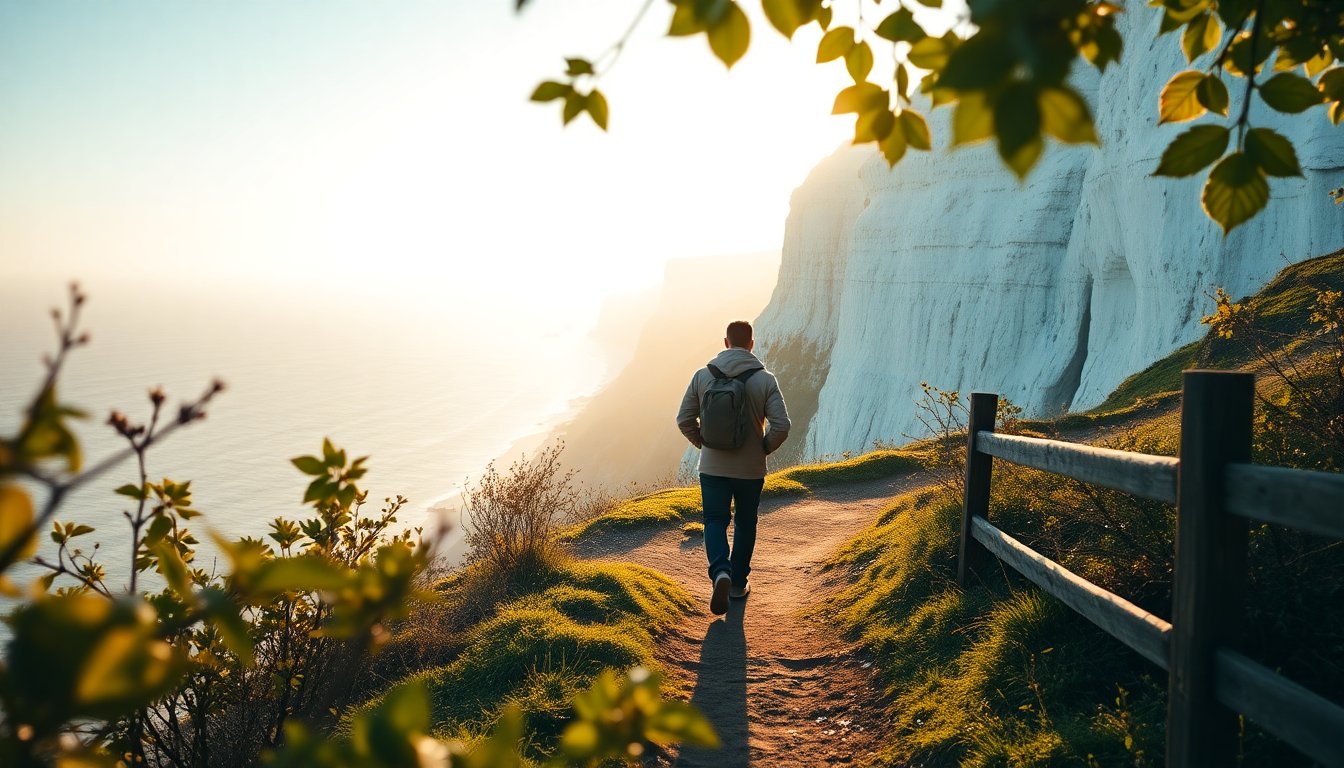
The northeastern tip of the island of Rügen in Mecklenburg-Vorpommern shelters a compact but striking protected area: Jasmund National Park. At roughly 3,100 hectares it is Germany’s smallest national park, yet its variety of scenery—bright chalk escarpments, dense beech woodland recognised by UNESCO, peat hollows and small forest lakes—feels much larger. The park’s white rock was formed from marine sediments deposited some 70 million years ago, so the cliffs are not only visually dramatic but also geological archives that record deep time. Artists of the Romantic era, most famously Caspar David Friedrich, transformed these coasts into enduring images of northern sublimity.
Beyond postcard panoramas, Jasmund rewards attention to small details: waves occasionally wash up polished fossils and shards of flint, roots clutch the cliff edges in contorted formations, and sudden mist can thread through the trunks. Walk a little off the busiest tracks and the soundscape simplifies to wind in leaves, seabirds calling and the distant crash of the sea below. Those who look closely will see how the park is not static but continually reshaped by erosive forces that reveal and reclaim fragments of the past.
Main sights and viewpoints
Königsstuhl and the skywalk
The most recognisable landmark is the cliff called Königsstuhl, a vertical chalk face that rises to about 118 metres above the Baltic Sea. The name, often translated as the “Sofa of the King” or the “King’s chair,” carries with it folklore about rulers and trials of courage. From the rim you can scan a shoreline of white cliffs and jade-tinged water stretching along the peninsula. Since 2026 a contemporary skywalk has been installed at the main viewing area, extending over the slope and offering a thrilling vantage point that projects the visitor visually into the void above the sea.
Victoria-Sicht and the Stubbenkammer
A short distance from the main platform lies Victoria-Sicht, a viewpoint named after a royal visit in the nineteenth century and prized for one of the finest frontal views of Königsstuhl. Nearby the coastline unfolds into the jagged terraces of the Stubbenkammer, a sequence of serrated cliffs and ledges that so inspired Friedrich. The northern reaches of the park reveal a contrast of closed forest and sudden windows onto the water, where every angle of light seems to change the mood of the landscape.
Woodland interiors, lakes and shifting cliffs
Inland from the escarpment, the Stubnitz beech forest forms the largest continuous stand of beech along the Baltic shore. The trees are tall and closely spaced, and the forest floor hosts springs, small hollows and drainage valleys carved by water. Fallen trunks are commonly left to decay in place as part of the park’s conservation approach, supporting insect life and new growth. Hidden among the trees is Herthasee, a small lake wrapped in local myth as a former site of ritual significance, which today offers a rare, hushed clearing from which to contemplate the ancient woodland.
Along the coast visitors can also find the remnants of formations like the Wissower Klinken, which historically featured in landscape paintings but have partly collapsed in recent years—a reminder of the coast’s active reshaping. Erosion is not only a hazard but also a force that exposes fossil-rich layers and continually alters the park’s appearance; watching the sea and cliffs is watching a slow, ongoing process of change.
Activities, access and practical tips
There are several ways to experience Jasmund: the Hochufer trail runs along the cliff tops and is considered one of northern Germany’s finest coastal walks, alternating exposed headland views with shaded forest stretches. A common route begins in Sassnitz and follows roughly ten kilometres into the park, passing port scenes, woodland and the white walls of the cliffs in sequence. For another perspective, seasonal boat tours depart from Sassnitz, Binz and Sellin, revealing the vertical scale of the rock faces from the water and showing how the forest crowns the cliffs.
The modern Nationalpark-Zentrum Königsstuhl beside the main access point is an excellent first stop: interactive exhibits explain the park’s geomorphology, the flora and fauna, and the history of the cliffs’ formation during glacial periods. Practical travel links run via Stralsund to the island of Rügen, with onward connections toward Bergen auf Rügen and Sassnitz. Local buses link the towns to the park entrance at the center, and many visitors park in the Hagen lot and continue by shuttle or walk the roughly 2.5-kilometre path past Herthasee.
When to go and closing thoughts
Jasmund takes on different personalities through the seasons: autumn paints the beech canopy in warm tones while low-angle light sculpts the cliffs; early mornings bring quiet trails and soft moisture in the wood. Wildlife watchers can encounter a range of insects and raptors, and with luck even see a sea eagle. Whether you visit for a single day hike, a small trip around the island, or from the deck of a coastal boat, the combination of chalk cliffs, old beech forest and the changing Baltic gives Jasmund a memorable intensity that lingers long after you leave.


